







Warehouse Humidity Control for Bulk DTF Film Inventory
Protect bulk DTF film inventory with warehouse humidity control: 40-55% RH & 15-24C targets, dehumidifier sizing, oil-return prevention, FIFO & B2B SOPs.

Key Takeaways: Warehouse humidity control is a frontline quality-assurance system for any distributor or commercial print shop holding bulk Direct-to-Film (DTF) inventory. Because DTF PET film relies on a porous, water-receptive ink coating, prolonged storage above 60% relative humidity (RH) causes ink pooling, oil return, edge curl, and powder clumping, whereas dry winter air below 35% RH triggers severe static electricity and stray powder contamination. Maintaining a controlled warehouse band of 40% to 55% RH and 15 to 24 degrees Celsius (60 to 75 degrees Fahrenheit)—paired with continuous-drain dehumidifiers, elevated plastic pallets, intact vapor-barrier packaging, and strict FIFO lot rotation—preserves full 12-month shelf life. At HAIYI, we engineer humidity-resilient DTF film coatings and moisture-barrier export packaging to protect bulk distributor stock from ocean transit through final printroom release.
Reading time: 9 minutes
Why Is Bulk DTF Film So Sensitive to Warehouse Humidity?
Although the structural carrier of DTF transfer film is hydrophobic Polyethylene Terephthalate (PET), the printable top surface is a precision-engineered hydrophilic (water-receptive) porous coating formulated to absorb water-based CMYK and white pigment inks instantaneously without bleeding. That exact microscopic porosity makes DTF film inherently hygroscopic: when ambient warehouse humidity climbs above 60% RH for days or weeks, moisture vapor diffuses through unsealed cartons and partially open sleeves directly into the ink-receiving layer.
For B2B distributors holding 500 to 5,000+ rolls (60 cm x 100 m) across seasonal weather swings, uncontrolled warehouse humidity quietly destroys inventory value before a single meter reaches a customer’s printer. Worse still, moisture-damaged film often looks visually normal until the customer runs a heavy white-ink gang sheet—triggering sudden ink pooling, patchy peeling, and costly batch-return disputes. Treating warehouse climate control as part of your technical QC infrastructure protects both margins and brand reputation.
Target Climate Band: Balancing Moisture Damage Against Static Electricity
Effective bulk DTF film warehousing is not simply about making a room as dry as possible; it requires holding relative humidity inside a disciplined 40% to 55% RH operating window (with 60% RH as the hard upper alarm limit) and temperature between 15 and 24 degrees Celsius (60 to 75 degrees Fahrenheit) with daily temperature swings kept below +/- 3 degrees Celsius.
- Above 60% RH (Moisture Damage Zone): The hydrophilic ink-receiving coating absorbs water vapor, reducing its capacity to hold high-density 200% to 300% DTF ink loads. Prints develop wet “water edges,” white ink migrates into CMYK borders, film edges curl in the curing tunnel, and nearby TPU hot-melt powder absorbs moisture and clumps inside shaker hoppers.
- 40% to 55% RH (Optimal Bulk Storage Band): Keeps the ink-receiving coating chemically dry and crisp while providing enough ambient conductivity to bleed off mild triboelectric charges. Unopened rolls stored in this band consistently retain factory release force and print sharpness for 9 to 12 months.
- Below 35% RH (Static Hazard Zone): Over-dried winter warehouses or unmonitored electric-heat bays allow PET webs to build heavy electrostatic charges during slitting, packing, and unwinding. High static attracts airborne warehouse dust and causes hot-melt powder to cling stubbornly to blank film margins during production.
Diagnosing Storage-Induced DTF Film Defects: Oil Return, Bleeding, Curl & Condensation
When a downstream print shop reports sudden print defects on a previously proven film SKU, matching the symptom to its warehouse climate root cause separates true coating defects from storage excursions:
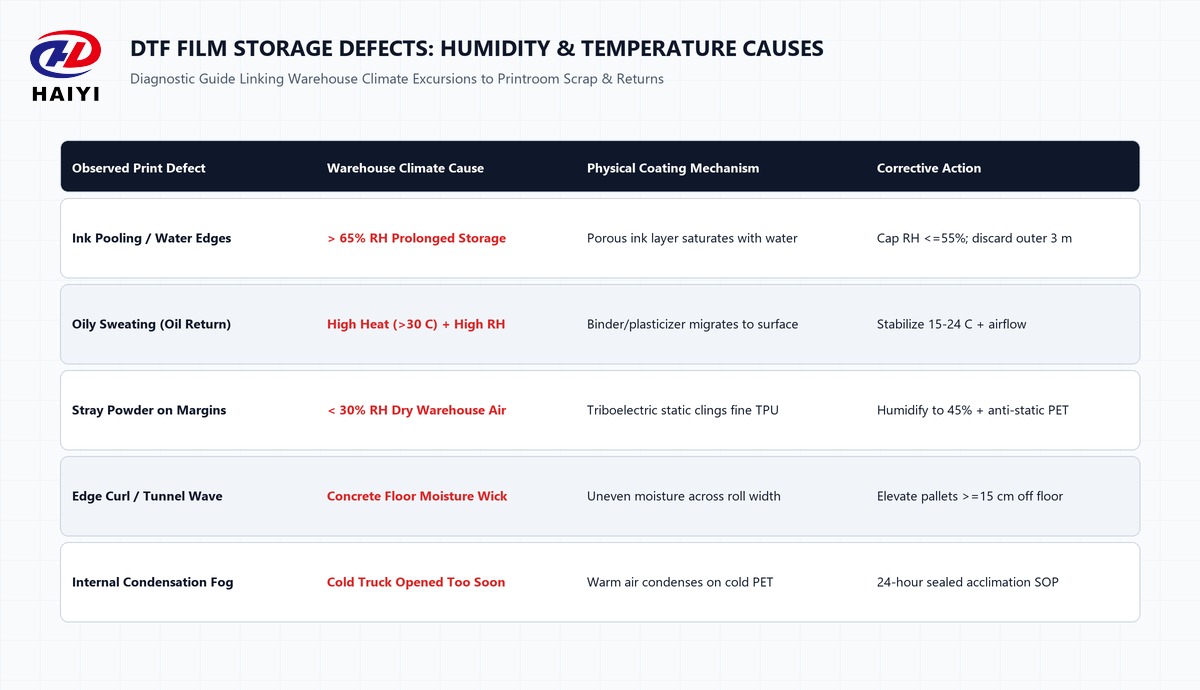
| Observed Defect | Primary Climate Trigger | Underlying Coating Mechanism | Preventive / Corrective Action |
|---|---|---|---|
| Ink Pooling / “Water Edges” | Sustained storage > 60-65% RH | Pre-saturated porous coating cannot absorb wet ink | Lock warehouse <= 55% RH; trim & discard outer 3–5 m of exposed roll |
| Oily Droplets (“Oil Return”) | Heat > 30 deg C + high humidity | Chemical humectants or binder components sweat to surface | Hold 15–24 deg C with air circulation; avoid non-AC summer bays |
| Stray Powder Haze on Blank Film | Dry winter air < 30-35% RH | Triboelectric static pulls fine TPU onto unprinted areas | Humidify printroom to 45% RH; specify anti-static double-matte PET |
| Wavy Tracking / Edge Curl | Floor moisture wicking or uneven RH | Roll edges absorb moisture faster than tightly wound center | Elevate all cartons >= 15 cm on plastic pallets; keep barrier bags sealed |
| Surface Haze / Condensation | Cold freight opened immediately | Warm indoor vapor condenses on cold PET film surface | Enforce mandatory 24-hour sealed acclimation before opening |
Note that condensation from cold winter trucks or hot summer containers is a short-term thermal-shock event distinct from chronic warehouse humidity; for step-by-step post-delivery warming protocols, review our guide on how to acclimate DTF film after cold or hot transportation.
Warehouse Infrastructure: Dehumidifier Sizing, Zoning, and Multi-Point Monitoring
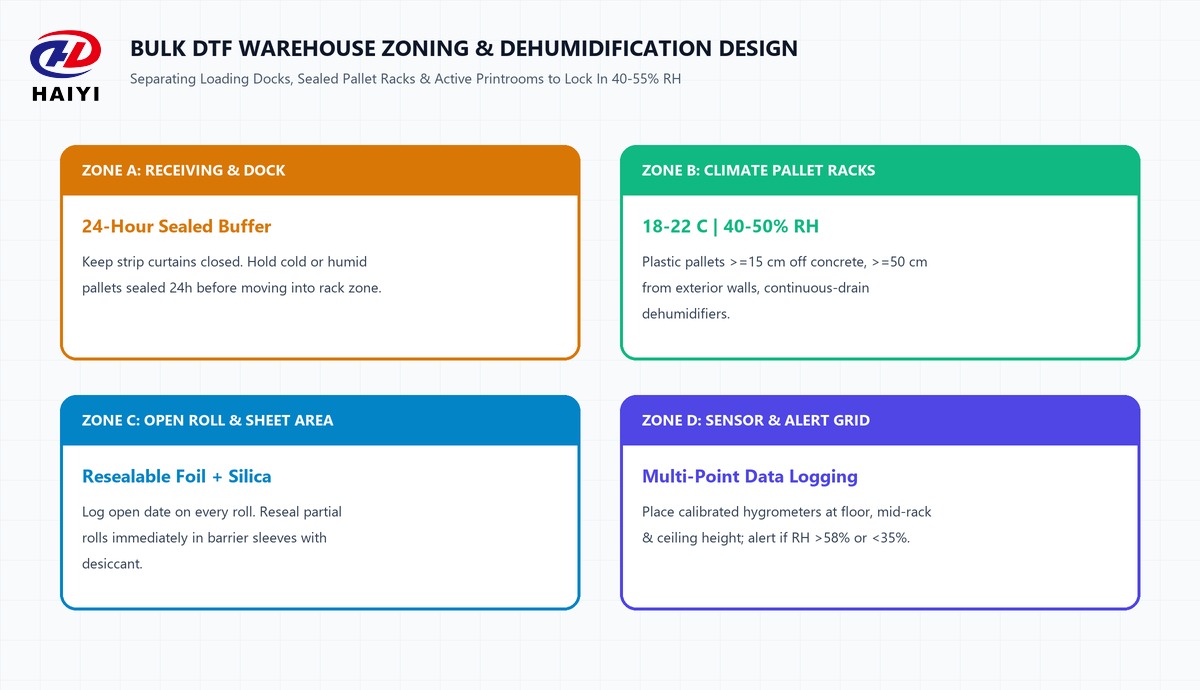
Most consumer blog posts simply say “buy a dehumidifier” without explaining why residential portable units fail inside a 300 to 2,000 square meter distributor warehouse. Engineering a reliable bulk DTF storage zone requires four practical facility controls:
1. Choose Refrigerant vs. Desiccant Dehumidifiers by Climate
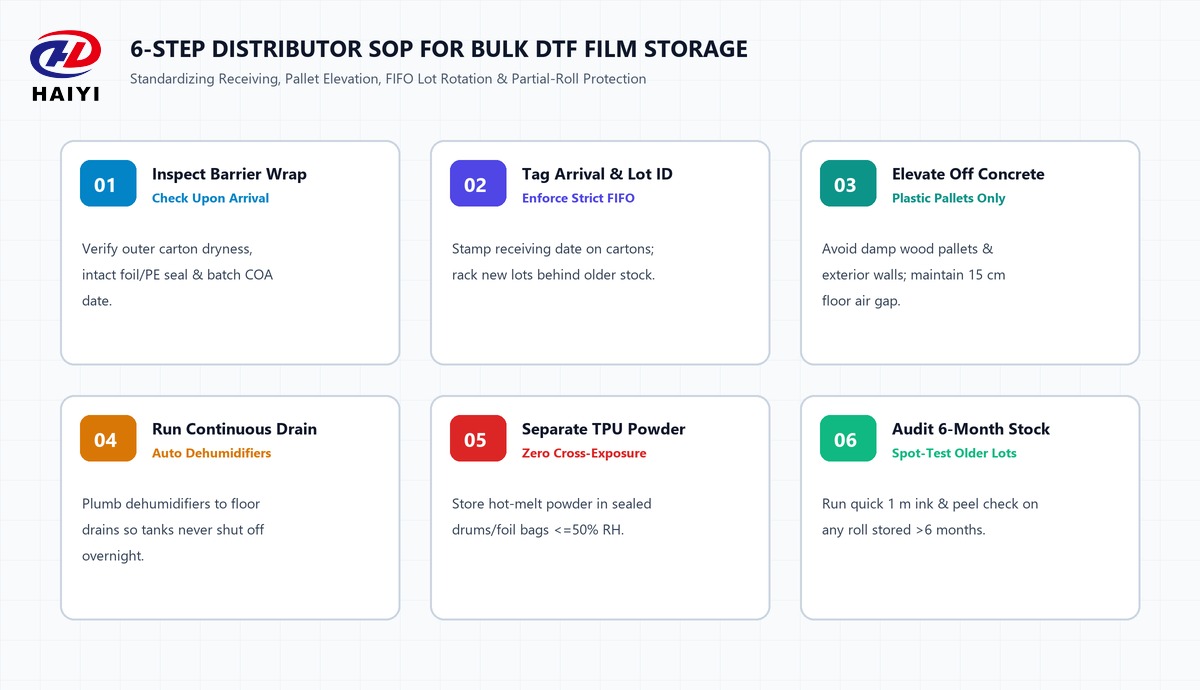
In warm, humid coastal regions (such as Southeast Asia, the US Gulf Coast, Southern China, or Latin American port cities where ambient temperatures stay above 18 degrees Celsius), commercial refrigerant dehumidifiers plumbed directly into floor drains deliver the lowest kilowatt-hour operating cost. In cool, damp northern winters (ambient temperatures below 12 to 15 degrees Celsius), refrigerant coils frost up and lose efficiency—requiring rotary desiccant dehumidifiers to hold 45% RH reliably year-round. Always plumb condensate lines to continuous drains rather than relying on staff to empty internal water buckets that shut off automatically overnight.
2. Isolate the Bulk Film Zone From Loading Docks and Exterior Walls
Every time a forklift opens an unsealed dock door during a rainstorm, humid outdoor air floods the building. Partition your high-value DTF film and TPU powder racking inside an enclosed climate-controlled bay fitted with fast-closing PVC strip curtains or air curtains. Keep all pallet racks at least 50 cm (20 inches) away from exterior concrete or metal-clad walls, which radiate summer heat and sweat during cold nights.
3. Elevate Stock on Plastic Pallets — Never Bare Concrete or Damp Wood
Concrete warehouse slabs wick ground moisture continuously through capillary action, even when they look dry. Never stack DTF cartons directly on the floor. Furthermore, avoid green or damp heat-treated wooden pallets that release trapped wood moisture straight into bottom-tier cartons; use inert HDPE plastic pallets or steel racking elevated at least 15 cm off the floor.
4. Deploy Multi-Height Data-Logging Hygrometers
Warm, humid air stratifies vertically inside high-bay warehouses. A single wall thermostat at eye level can read 21 degrees Celsius and 48% RH while top-tier racks near an uninsulated roof deck bake at 33 degrees Celsius and bottom pallets sit at 64% RH. Mount calibrated digital data-logging hygrometers at floor level, mid-rack, and top-rack height, configured with automated SMS/email alerts whenever RH crosses 58% or drops below 35%.
Packaging, Roll Orientation, and FIFO Inventory Governance
Even inside a climate-controlled room, physical handling and stock rotation determine whether the last roll on a pallet performs identically to the first.
- Preserve Factory Vapor-Barrier Packaging: Unopened bulk rolls should remain sealed inside their original moisture-barrier PE or aluminum-foil sleeves with protective end-caps until the exact day of use or distributor dispatch. Never slice open sleeves just to check film appearance during receiving.
- Prevent Core Crushing & Flat Spots: Store master 60 cm x 100 m rolls suspended by their 3-inch core end-caps inside rigid 5-ply cartons, or stacked horizontally no higher than the manufacturer’s rated carton load limit. Excessive vertical stacking weight compresses the outer wraps, creating permanent pressure bands (“blocking”) that show up as glossy stripes across solid prints.
- Reseal Opened Partial Rolls Immediately: If a sample roll or production roll is partially used, slide it back into an opaque moisture-barrier bag with fresh 50 g silica-gel desiccant packets and seal it airtight. Plan to consume opened rolls within 30 to 60 days.
- Enforce Strict FIFO (First-In, First-Out) by COA Lot Number: Label every incoming pallet with its arrival date and factory batch code (verified against the DTF film Certificate of Analysis). Rack newly arrived containers behind older stock so no roll sits forgotten in a back corner beyond 9 to 12 months.
- Spot-Test Any Inventory Stored Longer Than 6 Months: Before shipping an older pallet to a key print-shop account, pull 1 meter for a quick 250% heavy-ink and peel verification test (following our DTF consumables compatibility test protocol) to guarantee 100% customer satisfaction.
Special Considerations: Storing Oil-Based vs. Water-Based Release Films and TPU Powder
Not all DTF consumables react to warehouse humidity at the same speed. Distributors carrying a full catalog—such as those structured in our DTF film SKU matrix guide—should apply tiered storage discipline:
- Oil-Based vs. Water-Based Release Coatings: Standard oil-based release DTF films offer slightly broader humidity tolerance during ocean transit and coastal warehousing, whereas water-based release films are more sensitive to prolonged exposure above 60% RH and must always be prioritized for the tightest 40%–50% RH climate zone.
- Specialty DTF Films (Glitter, Reflective, Metallic): Heavy-coated specialty films such as reflective DTF film and glitter film contain thicker functional layers that curl faster if exposed to uneven ambient humidity; keep them sealed in barrier foil until print day.
- Hot-Melt TPU Powder Co-Storage: TPU adhesive powder is even more hygroscopic than PET film. Store bulk 20 kg powder sacks inside airtight HDPE drums or intact foil bags below 50% RH, and never leave open powder bins next to unsealed film racks.
Frequently Asked Questions About Warehouse Humidity Control for Bulk DTF Film
What is the ideal humidity and temperature for storing bulk DTF film?
Maintain bulk DTF film warehouses between 40% and 55% relative humidity (never exceeding 60% RH) y 15 to 24 degrees Celsius (60 to 75 degrees Fahrenheit). Keeping climate stable within this band prevents ink-coating moisture saturation, oil return, edge curling, and dry-air static buildup.
How long is the shelf life of unopened bulk DTF film rolls?
When stored unopened in original moisture-barrier sleeves inside a climate-controlled warehouse (40%–55% RH, 15–24 degrees Celsius), high-quality DTF PET film maintains full print and peel performance for 12 months (and up to 18 months for oil-based double-matte coatings). Once unsealed, opened rolls should be resealed with desiccant and used within 30 to 60 days.
Can I salvage a DTF film roll that absorbed moisture in a humid warehouse?
Because moisture diffuses from the exposed outer wraps inward, a mildly affected roll can often be salvaged by stripping off and discarding the outer 3 to 5 meters, acclimating the roll in a 45% RH room for 24 hours, and running a test print. If oil return or ink bleeding persists deep inside the roll, the hygroscopic coating is permanently degraded and should be quarantined.
Why does DTF film curl inside the curing oven after humid storage?
When the edges of a wound roll absorb ambient humidity while the inner core stays dry, uneven moisture expansion creates internal stress across the PET coating. Once the film enters a 130 to 150 degrees Celsius curing tunnel, rapid moisture evaporation shrinks the damp edges unevenly, causing upward curl and head-strike or conveyor jams.
How does factory export packaging protect DTF film during 35-day ocean shipping?
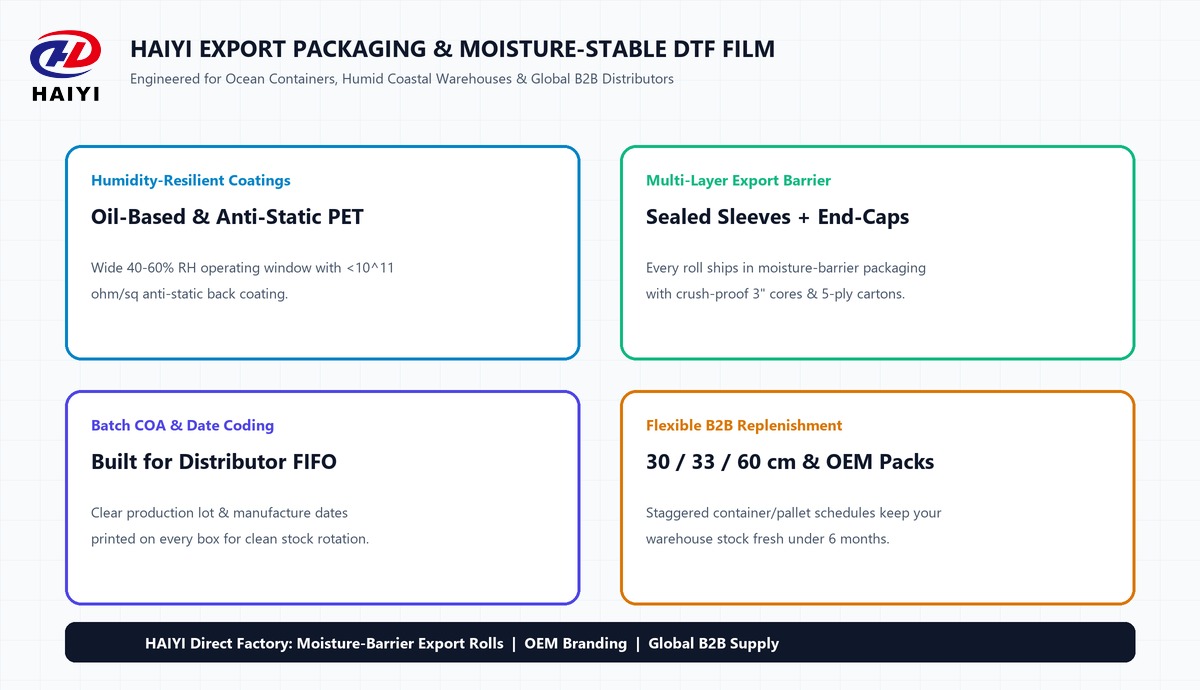
Ocean containers experience severe day-to-night temperature swings (“container rain”). Reputable DTF film factories seal every roll inside thick moisture-barrier sleeves with crush-proof 3-inch cores, pack them into reinforced 5-ply export cartons with silica desiccant, and palletize them with stretch wrap so coastal humidity never reaches the coating during transit.
Source Moisture-Stable Wholesale and OEM DTF Film Direct from HAIYI
Protecting bulk inventory starts at the factory coating line and export packaging bay long before a container reaches your warehouse dock. At HAIYI, we manufacture humidity-resilient 75 um and 100 um double-matte DTF transfer films backed by in-house R&D coating laboratories, verified anti-static back treatments, clear batch COA date-coding for clean FIFO rotation, and multi-layer moisture-barrier export packaging built for global ocean freight.
Whether you are a regional distributor planning staggered quarterly replenishment to keep warehouse stock fresh under 6 months, or an established brand seeking custom OEM/ODM private-label DTF film rolls with tailored barrier packaging, review our DTF film ultimate buying guide for distributors or contact HAIYI today to request sample rolls, COA specs, and wholesale pricing.