







Matte vs Glossy Release Film: How the Final Surface Changes
How matte and glossy DTF release films shape the final transfer surface: print side vs back side, how the release texture is copied onto the ink, peel and re-press effects, gloss measurement, garment matching, testing and stocking advice for distributors.

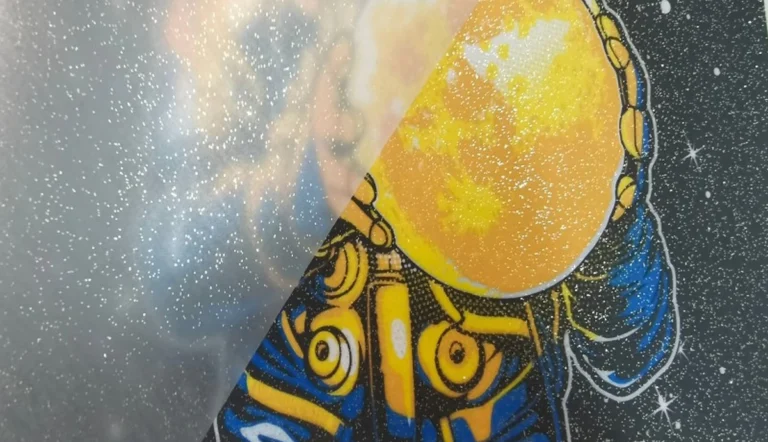
Quick answer: In DTF printing, the release layer of the film works like a mold for the top surface of the transfer. A glossy (smooth) release surface usually leaves a smoother, shinier print with stronger color saturation, while a matte (micro-textured) release surface leaves a flatter, low-reflection print that looks closer to screen printing and feels less plastic. The final surface also depends on peel temperature and any re-press with a finishing sheet, so the same film can give different results. The matte or glossy back side of a film mainly affects printer feeding and static, not the look of the transfer.
This article explains how the release film shapes the final surface of a DTF transfer, compares matte and glossy results on different garments, shows how peel method and post-press change the finish, and gives a simple way to test and specify the finish you want. It is written for print shops, transfer producers and distributors who choose and stock DTF films. For the basics of film types, see our guide on hot, cold and instant peel DTF film.
What does matte or glossy mean on a DTF film?
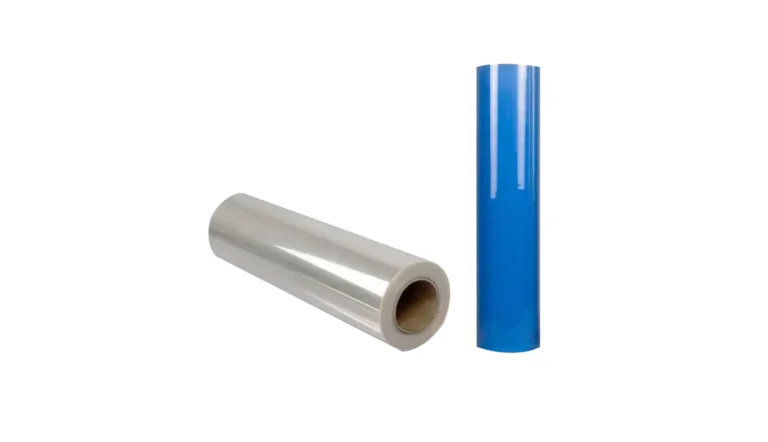
On a DTF film, matte or glossy can describe two different surfaces: the print side, which carries the ink-receiving and release coatings, and the back side, which touches the printer platen and rollers. Confusion between these two sides explains why published opinions disagree about whether matte and glossy films change the look of the transfer.
| سطح | What matte or glossy changes | Effect on the transfer |
|---|---|---|
| Print side (release and ink layer) | Micro-texture that the ink and adhesive replicate | Changes gloss, color saturation and hand feel |
| Back side (non-print side) | Friction, static and feeding stability | Little or no direct change to the transfer finish |
A double-sided matte film, for example, has a matte back for stable feeding and a coated print side whose release texture decides the finish. When comparing films, always ask which side the term matte or glossy refers to. See single-sided vs double-sided DTF film for the feeding side of the question.
How does the release film shape the final surface of a DTF transfer?
The release film shapes the final surface because the ink and adhesive are pressed against it while they melt and cool. When the PET carrier is peeled away, the top of the transfer keeps a negative copy of the release surface: a smooth release surface leaves a smooth, reflective top, and a micro-textured release surface leaves a slightly rough top that scatters light and looks matte.
- Ink is printed onto the coated release side of the film.
- Hot melt powder is applied and cured, bonding to the ink.
- The transfer is pressed onto the garment, and the ink surface softens against the film.
- As the transfer cools, the ink surface sets in the shape of the release texture.
- The film is peeled, revealing a glossy or matte surface depending on the release layer and peel timing.
For the full layer structure, see DTF film layer structure و كيف يؤثر طلاء فيلم DTF على جودة الطباعة.

How do matte and glossy finishes compare on the garment?
Matte and glossy DTF finishes differ in reflection, perceived color, hand feel and how visible fingerprints and surface marks are. Glossy finishes look more vivid and shiny, while matte finishes look flatter, more natural and less plastic on most apparel.
| ملكية | Glossy finish | Matte finish |
|---|---|---|
| Light reflection | High, visible sheen | Low, glare-free |
| Color appearance | Higher saturation and contrast | Softer, more natural colors |
| Hand feel | Smoother, can feel more like plastic | Drier, softer feel |
| Look on cotton | Can look out of place on casual cotton | Closer to screen-printed ink |
| تفاصيل دقيقة | Very sharp edges and small text | Very fine texture can soften tiny details slightly |
| Surface marks | Shows scuffs and fingerprints more easily | Hides small marks and uneven areas |
| الاستخدام النموذجي | Bold graphics, sportswear, promotional items | Fashion apparel, streetwear, premium cotton |
On fabric, the difference is often subtler than on a flat sheet, because the fabric texture shows through the transfer after pressing. The difference is most visible on large solid areas and on smooth fabrics such as polyester.
How do peel temperature and peel method change the finish?
Peel temperature changes the finish because the ink surface is still soft when the film is removed hot and already set when the film is removed cold. With many films, a cold peel lets the ink set against the release surface and copies its texture more faithfully, while a hot peel separates the film earlier and often gives a more matte, slightly textured top.
| Peel method | Typical surface result | ملحوظات |
|---|---|---|
| قشر ساخن | Often more matte and textured | Fast production; finish depends on the release design |
| Warm peel | Between matte and glossy | Peel window must be controlled |
| Cold peel | Often smoother and glossier | Copies the release surface closely; slower |
These are typical tendencies, not fixed rules, because the release chemistry and texture of each film differ. Always test the peel method the film is designed for; a cold-peel-only film can be damaged if peeled hot. See the DTF peel-test SOP و how to find the correct peel window.
Can a re-press change a glossy transfer into a matte one, or the reverse?
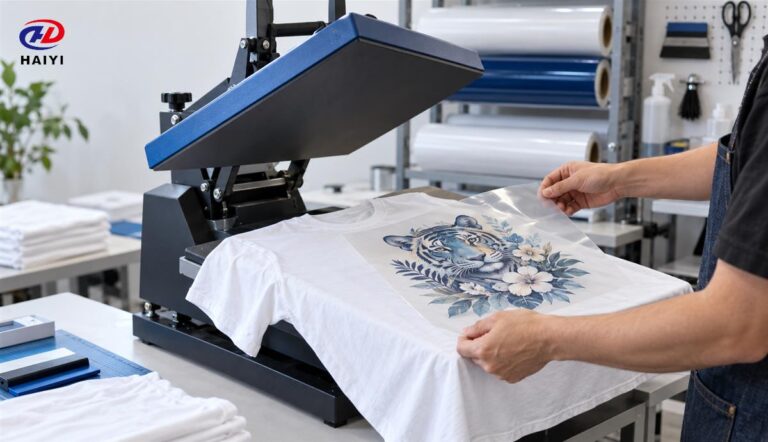
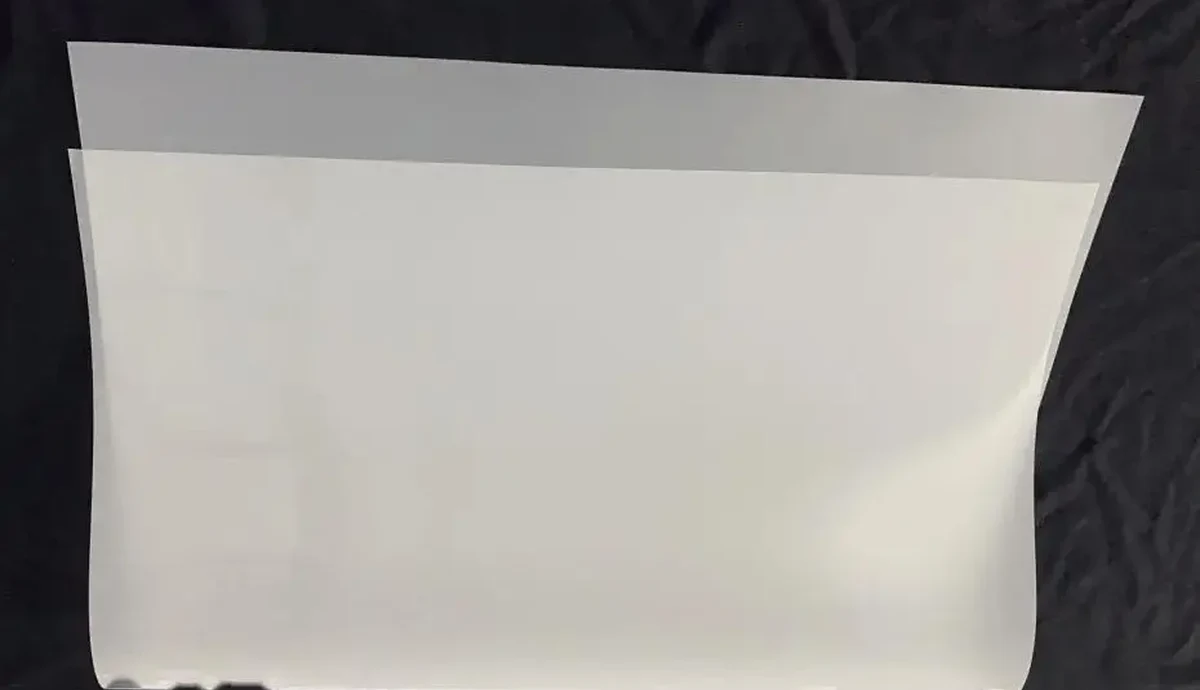
Yes. A second press after peeling can change the final surface. Pressing the finished transfer under a matte or textured finishing sheet gives a flatter, more matte surface, while pressing under a smooth sheet can increase gloss. The re-press also improves adhesion and wash durability for many films.
| Finishing step | Effect |
|---|---|
| Re-press with a matte or textured cover sheet | Reduces gloss, gives a softer look |
| Re-press with a smooth cover sheet | Increases gloss and smoothness |
| Re-press with fabric or textured cover | Adds fabric-like texture |
| No re-press | Finish depends only on film and peel method |
Keep re-press time short, often a few seconds, so that the transfer does not overheat. For press settings, see DTF heat press parameters و how long to press DTF film.
Does the finish change color, detail or wash durability?
The finish changes how color looks more than the color itself. A glossy surface reflects less scattered light and makes colors look deeper and more saturated, while a matte surface scatters light and makes the same colors look slightly lighter and softer. Fine detail is usually similar, but very fine release textures can soften extremely small text slightly. Wash durability depends more on ink, powder, curing and pressing than on finish.
| Factor | Main influence |
|---|---|
| Perceived color saturation | Surface finish |
| Actual ink color | Ink, color profile and white underbase |
| Edge sharpness | Ink-receiving coating and printing settings |
| متانة الغسيل | Powder, curing, pressing and garment |
| Crack resistance | Ink load, curing and stretch of the garment |
Many users report that matte surfaces age more evenly because small scuffs are less visible, while glossy surfaces can lose sheen in patches after many washes. For durability, see how to choose DTF film with strong wash resistance و why DTF prints crack after washing.
Which finish suits which garment and market?
The right finish depends on the garment, the design and the market the transfers are sold into. Matte finishes suit most cotton fashion and streetwear, where customers expect a screen-print look, while glossy finishes suit bold graphics, sportswear and promotional products where color pop matters more than a natural look.
| طلب | Recommended finish | سبب |
|---|---|---|
| Cotton T-shirts and hoodies | Matte | Natural look, soft feel |
| Streetwear and fashion brands | Matte | Premium, screen-print style |
| Sportswear and polyester jerseys | Glossy or matte | Glossy for vivid team colors, matte for technical look |
| Promotional and event shirts | Glossy | Bright colors at a glance |
| Bags, caps and workwear | Matte | Hides scuffs in daily use |
| Kids and character designs | Glossy | Saturated, cartoon-like color |
For pressing on cotton, see DTF film for cotton T-shirts.
Which release coating properties decide the finish?
The finish a film produces is decided mainly by three properties of its release coating: surface texture, release chemistry and coating uniformity. Texture sets how much light the transfer surface scatters, release chemistry sets when and how cleanly the film separates from the ink, and uniformity sets whether the finish is even across the whole print and from roll to roll.
| Release property | Effect on the final surface |
|---|---|
| Surface texture or roughness | Higher micro-roughness gives a more matte finish; a very smooth surface gives gloss |
| Release chemistry | Controls peel temperature window and how cleanly the surface separates |
| قوة التحرير | Too high can tear or drag the surface; too low can lift the transfer early |
| Coating weight and uniformity | Uneven coating causes patchy gloss and peel differences |
| Heat stability | Keeps the texture stable at pressing temperature |
Because these properties are set during coating, the finish of a film is a manufacturing specification, not only a marketing label. Ask suppliers how they control texture and release force between batches. See DTF film release force testing و how to measure DTF film coating weight and uniformity.
How does the finish interact with special effect films?
Special effect films such as glitter, reflective, glow in the dark and color change films have their own surface behavior, so the matte or glossy choice works differently with them. Glitter and reflective effects depend on light reflection from particles in the transfer, which a strong matte top layer can partly soften, while glow and color change effects are less affected by surface gloss.
| Special film | Finish consideration |
|---|---|
| Glitter film | Smoother surfaces let the sparkle show more clearly |
| فيلم عاكس | Surface texture can reduce reflection; follow the film settings |
| Glow in the dark film | Finish mainly changes daytime appearance |
| Color change film | Finish changes look, not the color change effect |
For glitter designs, see glitter DTF film design rules.
What should a buyer specify when ordering a matte or glossy film?
A buyer should specify the finish together with the peel method, film thickness, roll size and the test conditions used to judge the finish. Specifying only matte or glossy leaves too much open, because the same word can describe different surfaces and different peel behaviors.
- Which side is matte or glossy: print side, back side or both.
- Intended peel method: hot, warm or cold.
- Target finish, ideally as a gloss range measured at 60° on an approved sample.
- PET thickness, roll width and length or sheet size.
- Printer, ink and powder the film will be used with.
- Batch labeling and the retained sample used for future comparisons.
How can you measure the finish objectively?
The finish of a DTF transfer can be measured with a gloss meter, which reports gloss units (GU), usually at a 60° angle for general surfaces. Measuring gloss turns matte and glossy into numbers that can be compared between films, batches and production lines.
| Gloss level at 60° | Typical description |
|---|---|
| Below about 10 GU | Matte |
| About 10 to 70 GU | Semi-gloss or satin |
| Above about 70 GU | Gloss |
- Measure on a flat, solid color area pressed on a smooth fabric or test panel.
- Take several readings and use the average.
- Record film batch, peel method, press settings and any re-press.
- Compare with an approved reference sample under the same light for visual checks.
If a gloss meter is not available, a simple side-by-side visual comparison under a fixed light source at a low viewing angle still reveals most differences.
How should a print shop test matte and glossy films before choosing?
A print shop should test matte and glossy films side by side with its own printer, ink, powder, press and garments, because the final surface depends on the whole system. A short, structured test shows both the finish and any change in peel behavior, color or wash performance.
- Print the same test file on each film, with solid areas, gradients and small text.
- Cure all samples with the same powder and curing settings.
- Press on the garments you sell most, using the recommended settings for each film.
- Peel each film using its intended method and note the peel feel.
- Compare gloss, color and hand feel, with and without a re-press.
- Wash samples several times and compare finish retention and cracking.
Our DTF consumables compatibility test protocol gives a detailed version of this test.
How should distributors stock matte and glossy films?
Distributors should stock finishes based on what their customers print, not on a single preferred look. Many distributors carry a matte double-sided film as the main SKU for apparel, add a glossy or cold-peel option for customers who want vivid color, and label each product clearly with its finish, peel method and recommended settings.
| Customer group | Suggested stock |
|---|---|
| Apparel print shops | Matte hot peel film as the core SKU |
| Sportswear and promotional printers | Glossy or cold peel film |
| Mixed customer base | Both finishes, in 30 cm and 60 cm rolls |
| Premium brands | Matte film plus finishing sheet guidance |
Clear labels prevent customers from expecting a glossy finish from a matte film, which is a common source of complaints. See how to build a DTF film SKU matrix و how private label DTF film works for distributors.
How does the finish affect how end customers judge quality?
End customers often judge a DTF print by how it looks and feels in the first few seconds, and the finish strongly shapes that impression. A matte finish is usually read as premium and close to screen printing on fashion apparel, while a glossy finish is read as bright and eye-catching on promotional and sports products. A finish that does not match the garment can make a technically good print look cheap.
| Customer impression | Matte finish | Glossy finish |
|---|---|---|
| First look | Natural, understated | Bright, eye-catching |
| Touch | Soft, dry | Smooth, slick |
| Association | Screen print, fashion brand | Sticker-like, promotional |
| Under shop lighting | No glare, even look | Visible reflections on large areas |
For transfer sellers, showing customers a matte and a glossy sample of the same design on the same garment is one of the fastest ways to agree on the expected finish before a large order.
What are the most common finish problems and their causes?
The most common finish problems are uneven gloss across a print, an unexpectedly shiny matte transfer, a dull glossy transfer and texture marks from the press. Most of them come from peel timing, press temperature or the cover sheet rather than from the film alone.
| مشكلة | Typical cause | يصلح |
|---|---|---|
| Patchy gloss | Uneven pressure or temperature, partial early peel | Check press platen, peel evenly |
| Matte film looks shiny | Cold peel or smooth re-press sheet | Use recommended peel, matte cover sheet |
| Glossy film looks dull | Hot peel or textured cover sheet | Cold peel or smooth cover sheet if the film allows |
| Fabric or cover texture visible | Re-press too long or too hot with textured cover | Shorten re-press, change cover |
| Finish varies between batches | Release coating variation | Request batch records and compare samples |
For batch checks, see how to compare DTF film quality across two batches.
الأسئلة الشائعة
Is matte DTF film better than glossy?
Neither is better in every case. Matte suits most cotton apparel and a screen-print look, while glossy suits bold, vivid graphics. The choice depends on the garment and the customer.
Does a matte back side make the print matte?
Not by itself. The back side mainly affects feeding and static. The finish of the transfer comes from the release surface on the print side and from peel and press conditions.
Why does my cold peel film give a glossy finish?
Cold peel lets the ink set fully against the release surface, so it copies a smooth surface closely and often looks glossier than a hot peel result.
Can I make a glossy transfer matte after pressing?
Yes. A short re-press under a matte or textured cover sheet reduces gloss and gives a softer appearance.
Does the finish affect wash durability?
Wash durability depends mainly on ink, powder, curing and pressing. The finish mostly changes appearance, although matte surfaces tend to hide small wear marks better.
How do I keep the finish consistent across orders?
Use the same film, peel method and press settings, keep an approved reference sample, and check each new film batch against it.
Source matte and glossy DTF film wholesale from Haiyi
Foshan Haiyi Material Technology Co., Ltd. is a DTF film manufacturer in Foshan, Guangdong, China, with more than 10 years of experience in the coating industry. The company operates its own factory buildings with high-precision coating lines and slitting machines, has a production capacity of up to 60,000 square meters per day and has passed ISO 9001 and SGS.
For DTF distributors, wholesalers, print shops and brands, Haiyi offers:
- Single-side and double-side matte PET films with hot, warm and cold peel options, so you can offer different final finishes.
- Rolls of 30 cm x 100 m and 60 cm x 100 m and sheets, with customized sizes on request.
- Special effect films such as glitter, glow in the dark, reflective and color change films.
- Wholesale supply and customized films and packaging for private label distributors.
- Technical support for printing, peeling and pressing settings, and samples for testing on your own equipment.
To add matte or glossy finish films to your range, send us the finish and peel type you need, roll widths, monthly quantity and destination market. Email info@haiyidtf.com, message us on WhatsApp at 0086 13902298107 or use the contact page. You can also browse our DTF film products and learn more about Haiyi.