UV DTF A Film vs B Film: How to Select a Matched Pair
UV DTF A film vs B film: how the bond order works, which specs must match, mismatch symptoms and a pair test to select a matched A and B film pair.

Quick answer: UV DTF A film and B film are two halves of one transfer system:
- Film is the adhesive-coated printing film that receives the UV ink.
- Film klasy B is the clear transfer film laminated on top of the print, which lifts the design off A film and carries it to the final surface.
A matched pair has four things in common:
- the same width and core size
- a B film adhesive that grips the print more strongly than the A film liner holds it
- a B film that releases cleanly once the design touches the target surface
- lamination conditions that both films tolerate
The safest way to select a matched pair is to buy A and B film from the same supplier and approve them together with your own printer, ink and target surfaces.
What this guide adds: it explains:
- the peel force order that makes a pair work
- which specifications must match
- how to pair films for paper or transparent liners, foil effects and curved surfaces
- what mismatch looks like in production
- a step-by-step pair test
- how distributors should package and sell matched pairs
For the full printing workflow, see UV DTF printing process: from A film to finished transfer.
What does UV DTF A film do?
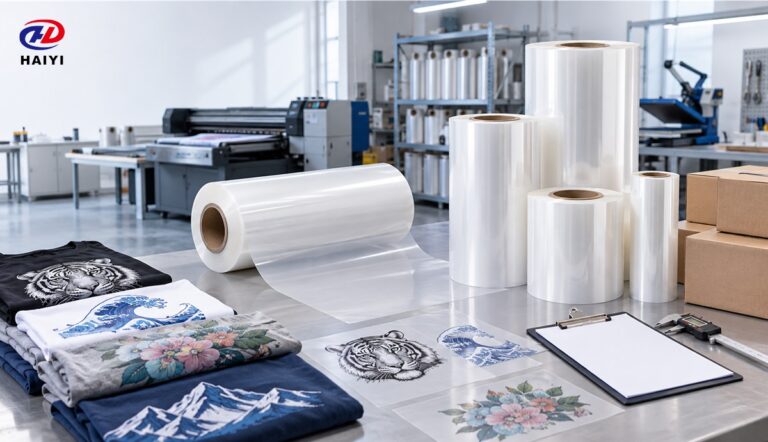
UV DTF A film is the printing substrate in the UV DTF process. It is a coated film, usually on a paper or transparent PET liner, with an adhesive layer on its printable surface. The UV printer lays down layers in sequence on that surface, typically adhesive or primer, white ink, color ink and varnish, and cures each layer with UV light. A film must feed flat through the printer, accept ink without spreading, stay dimensionally stable under UV exposure and release the cured design when B film is peeled away. Its glue layer later becomes the bonding layer between the transfer and the final surface.
What does UV DTF B film do?
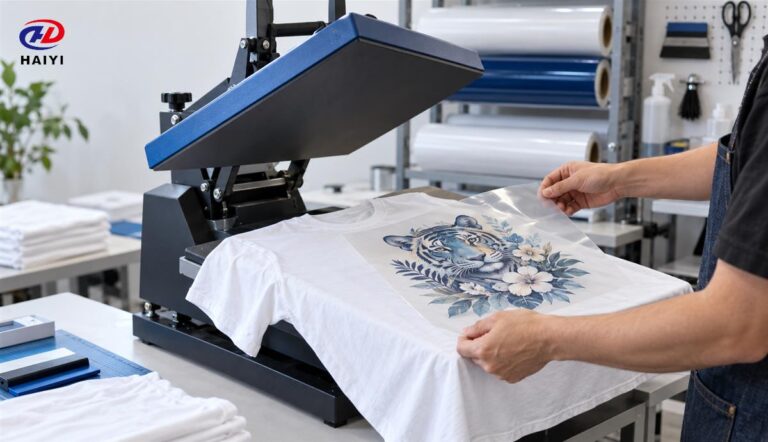
UV DTF B film is the transfer and application carrier. After printing, B film is laminated onto the printed side of A film. When the user peels B film away from A film, the printed design, including its glue layer, moves onto B film. The user then places B film on the target surface, presses the design down and peels B film away, leaving the design bonded to the surface.
B film must therefore do two opposite jobs:
- grip the design firmly enough to lift it off A film
- let go of it easily once the design is pressed onto the target surface
Optical clarity, flatness and a suitable adhesive level allow accurate placement and clean release.
Why must A film and B film be selected as a matched pair?
A film and B film must be matched because a UV DTF transfer only works when the release and adhesion forces between the layers follow a fixed order. Each film may pass its own tests and still fail as a pair if that order is broken. Two rolls can look identical in width, color and thickness while behaving very differently in transfer, because the critical properties are the adhesive and release coatings, which cannot be seen.
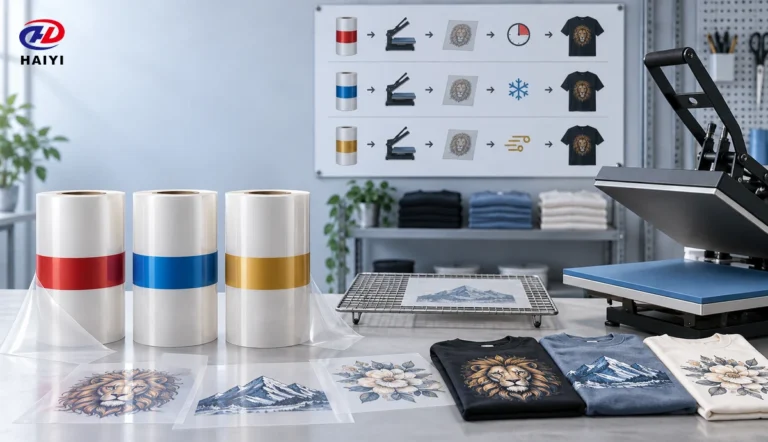
The working order can be described as three bonds:
- Bond 1: between the printed design and the A film liner. It must be the weakest, so that the design leaves A film completely.
- Bond 2: between B film and the top of the printed design. It must be stronger than bond 1, so that B film lifts every detail.
- Bond 3: between the design glue and the target surface. It must be stronger than bond 2, so that B film releases and the design stays on the product.
A matched pair keeps a comfortable margin between each bond. A mismatched pair narrows or reverses one of these margins. Release testing methods are described in DTF film release force testing methods and acceptance criteria.
| Bond | Between | Must be | If it is too strong | If it is too weak |
|---|---|---|---|---|
| Bond 1 | Printed design and A film liner | Weakest of the three | Details stay on A film, incomplete pickup | Design lifts early, shifts during printing or lamination |
| Bond 2 | B film and printed design | Stronger than bond 1, weaker than bond 3 | B film will not release from the product, design lifts off the surface | Fine details and small text are left behind on A film |
| Bond 3 | Design glue and target surface | Strongest of the three | No problem for transfer | Transfer peels off the product with B film |
Which specifications must match between A film and B film?
Several specifications must match between A film and B film. Some are physical and easy to check from a datasheet. Others concern adhesive behavior and can only be confirmed by testing. The table below lists the main matching points and why each matters.
| Specyfikacja | What to match | Dlaczego to ważne |
|---|---|---|
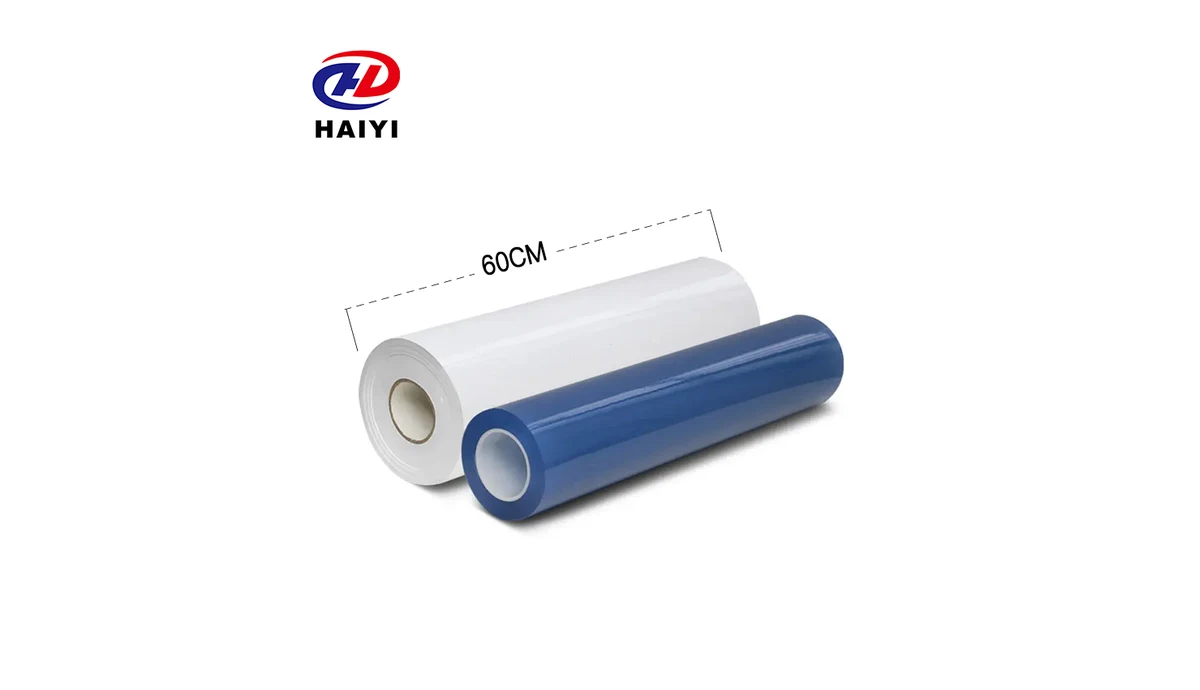
| Szerokość | Same nominal width, for example 30 cm, 33 cm, 40 cm or 60 cm | A narrower B film leaves exposed glue at the edges; a wider B film wastes material and can stick to rollers |
| Długość rolki | Same or proportional length, commonly 100 m | Both rolls run out together, which simplifies roll changes and inventory |
| Rozmiar rdzenia | Same inner core diameter, commonly 3 inch | Both rolls must fit the printer and laminator shafts |
| A film release level | Release force suited to the B film adhesive | Controls bond 1 and complete pickup |
| B film adhesive level | Tack strong enough to lift the design but clean on release | Controls bond 2 and clean application |
| Liner type | Paper liner or transparent PET liner A film with a B film tested on that liner | Liner stiffness and surface change release behavior |
| Lamination conditions | Both films rated for the laminator temperature and pressure used | Too much heat can over-bond B film; too little pressure leaves air gaps |
| B film thickness and stiffness | Suited to the application surface and handling | Thin, flexible B film follows curves; stiffer B film resists wrinkles and stretching on flat items |
Width, length and core size are easy to confirm. Release and adhesive levels are the properties most likely to cause hidden mismatch, so they need a physical pair test with the actual printing setup.
What problems does a mismatched A and B film pair cause?
A mismatched pair usually shows up in one of two ways. Either B film fails to lift the design from A film, or B film lifts the design but will not release it on the final surface. Recognizing the symptom helps identify which bond is out of balance.
| Symptom | Likely cause | Bond out of balance |
|---|---|---|
| Small text, thin lines or isolated dots stay on A film | B film adhesive too weak for the A film release level | Bond 2 too close to bond 1 |
| Design tears or splits during B film peel | A film release too tight, or varnish layer too weak | Bond 1 too strong |
| Design lifts off the product when B film is removed | B film adhesive too aggressive, or surface not suitable | Bond 2 stronger than bond 3 |
| Adhesive residue left on the product surface | B film adhesive transfer or excess glue at design edges | Bond 2 and glue layer mismatch |
| Bubbles or cloudy areas after lamination | Pressure, temperature or film flatness mismatch | Lamination conditions |
| Edges of the design stick to rollers or liner | B film narrower than A film, or design too close to edge | Width mismatch |
Many of these problems are wrongly blamed on ink or printer settings. Testing the same artwork with a known matched pair is the fastest way to separate film problems from process problems. More symptoms are covered in UV DTF film quality standards every importer should know.
How do paper liner and transparent liner A films affect B film choice?
The A film liner affects release behavior and handling, so the B film should be approved with the specific liner type.
- Paper liner A film: Lies flat, is easy to cut and is popular for sheet formats and general sticker production. Paper can respond to humidity, which may change flatness and release slightly in damp conditions.
- Transparent PET liner A film: Is more dimensionally stable, more resistant to humidity and allows the operator to see the design through the liner. Its release surface can behave differently from a paper liner.
A B film that works well with one liner type is not automatically correct for the other.
Buyers who stock both liner types should approve a B film for each, even if the same B film turns out to work with both. Haiyi supplies both formats as UV AB film with paper liner I transparent UV AB film, each designed as a matched set.
How should B film be matched for foil, glitter and raised varnish effects?
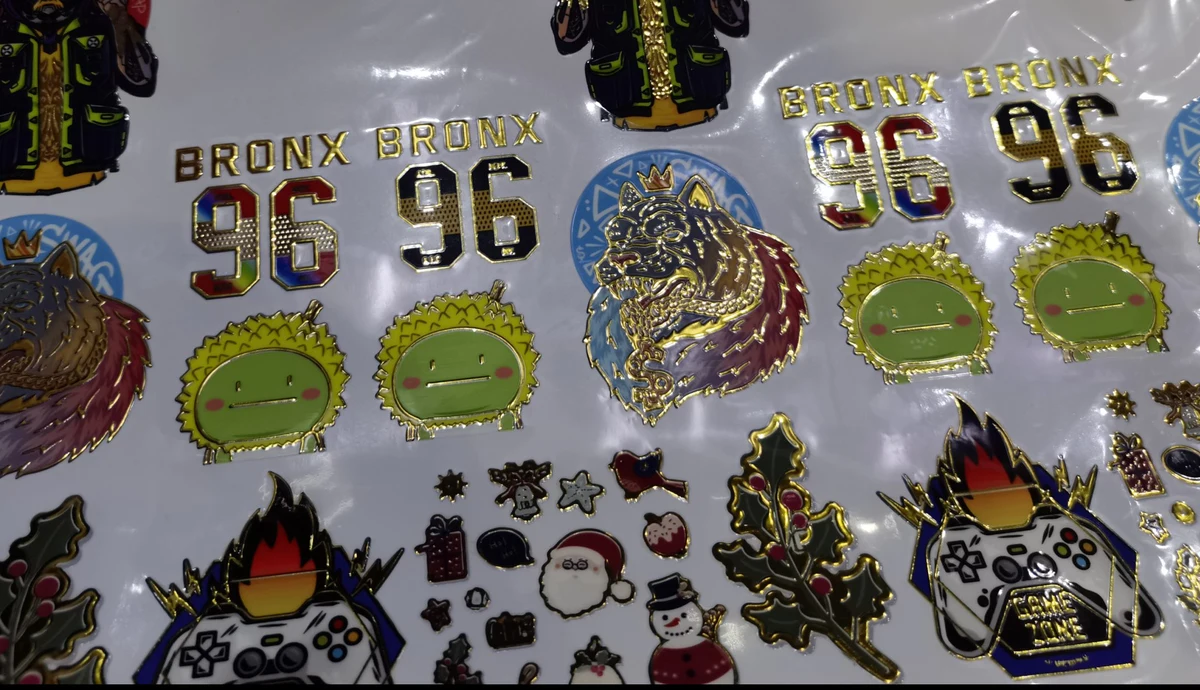
Special effect transfers place extra demands on the B film. Gold and silver foil A films, glitter effects and thick raised varnish all create a printed surface that is less flat and sometimes less receptive to adhesive than a standard print.
- Foil layers: Can have a smooth metallic top surface, which reduces B film grip on fine foil details.
- Raised varnish: Creates height differences, so B film must conform around edges without trapping air.
For effect transfers, buyers should test with the most detailed effect artwork they plan to sell, including thin foil lines, small foil text and high varnish areas. A matched pair for effect films usually needs slightly more B film conformability and a well-controlled A film release, so that foil details lift completely. Testing standard artwork alone may hide pickup problems that only appear on effect designs.
How does the target surface change which pair to choose?
The target surface determines how strong bond 3 can be, so it limits how aggressive the B film adhesive can be:
- Smooth, rigid surfaces such as glass, metal and glazed ceramics: These allow strong bonding, so a wide range of B film adhesive levels will release cleanly.
- Low surface energy plastics, textured surfaces, powder-coated items and slightly flexible materials: These form a weaker bond, so the B film must release more easily to avoid lifting the design.
Curved items such as tumblers, bottles and pens also favor a thinner, more conformable B film that can follow the curve without creasing.
A practical approach is to list the three or four surfaces that represent most of your sales and approve the pair on the most difficult of them. A pair that applies cleanly to textured plastic and curved metal will normally perform well on flat glass. The reverse is not guaranteed. Surface compatibility is discussed in UV DTF crystal labels: applications, surfaces and buying guide.
How do printer and laminator settings affect pair matching?
Printer and laminator settings change how strongly the layers bond, so a pair should be approved at the settings used in production:
- UV curing: Under-curing leaves the glue and ink softer and tackier, increasing bond 1. Over-curing can make varnish brittle.
- Lamination pressure: Too little pressure leaves air gaps that weaken bond 2.
- Lamination temperature: On machines with heated rollers, too much heat can over-bond B film so that it does not release later.
- Roll tension: Uneven tension between the two rolls causes wrinkles or diagonal stretching.
When a printer is replaced, a laminator is changed or curing lamps are upgraded, the approved pair should be retested. A setting change can move the bond balance as much as a film change can. Recording curing power, lamination temperature, pressure and speed during approval makes later troubleshooting much faster.
How do you test an A film and B film pair before ordering in bulk?
A structured pair test confirms that the bond order works with your equipment, ink and surfaces. The following steps form a practical protocol:
- Confirm the width, length, core size and liner type of both rolls against the order.
- Print a test file containing fine lines below 0.3 mm, small text, isolated dots, large solid areas, white-only areas and any foil or varnish effects you sell.
- Cure and laminate at your normal production settings and record the settings.
- Rest the laminated sheet for the time your workflow normally allows before peeling, then peel B film from A film at a steady angle.
- Inspect A film for details left behind and inspect the design on B film for tears or missing elements.
- Apply the transfer to each representative surface, press firmly, and peel B film after the dwell time you recommend to customers.
- Check for lifted edges, residue, bubbles and missing details on each surface.
- Recheck adhesion after 24 hours, and after any water, heat or abrasion exposure your customers expect.
A pair passes when pickup is complete on every element, the design releases cleanly on every surface and adhesion holds after 24 hours. Repeating the test with samples from a second production lot confirms that the pair is consistent, not only good once. A broader compatibility protocol is described in DTF consumables compatibility test: a step-by-step sample protocol.
Can A film and B film from different suppliers be mixed?
A film and B film from different suppliers can sometimes work together, but mixing raises risk and removes accountability. Different suppliers formulate release and adhesive coatings independently, so the bond order may fall within a narrow margin or change between lots. When a problem appears, each supplier can reasonably point to the other component.
Mixing is most acceptable when:
- a buyer has tested the specific combination thoroughly
- both suppliers can guarantee consistent lots
- the buyer has the technical ability to diagnose problems
For distributors and print shops that need predictable results, buying matched pairs from one manufacturer is simpler. The supplier designs the coatings together, tests them together and takes responsibility for the system.
How should distributors package and sell matched pairs?
Distributors protect their customers and reduce complaints when they keep approved pairs together from warehouse to end user. Good practice includes:
- creating one SKU for the A and B pair, or clearly linked SKUs
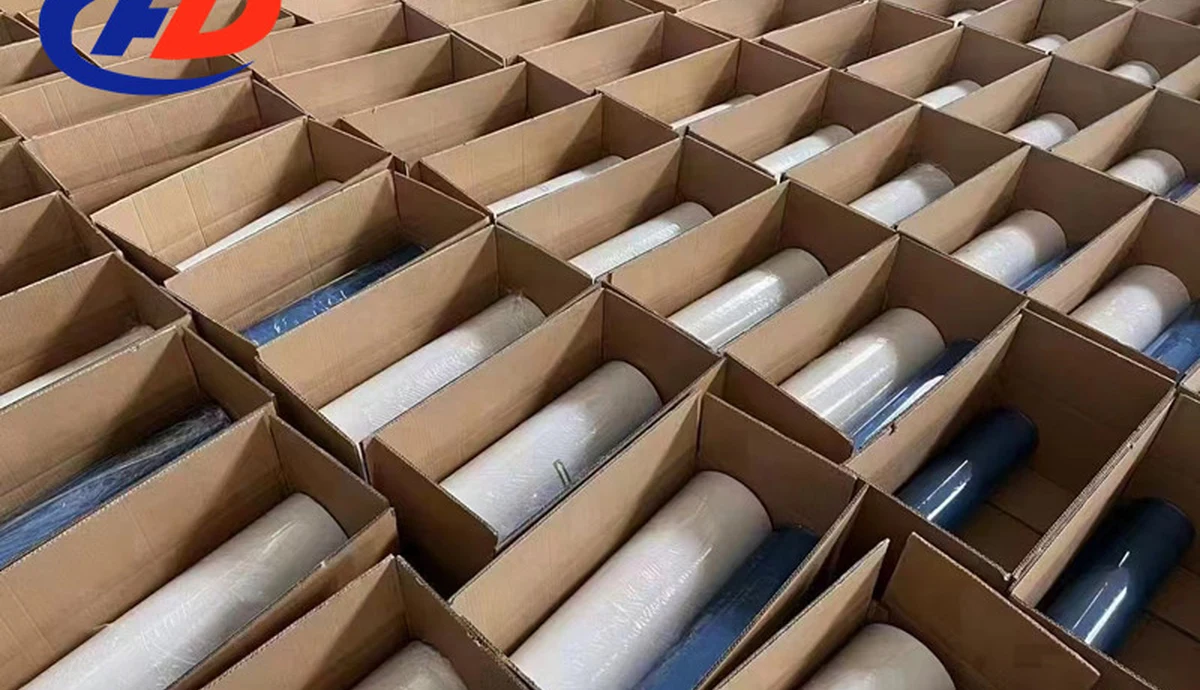
- packing paired rolls in the same carton
- labeling both rolls with matching product codes and lot numbers
- printing recommended lamination and application conditions on the label or insert
When a customer reorders, the distributor should supply the same pair from the same or a verified lot.
Storage should also be paired. Both films should be stored in the same conditions:
- away from direct sunlight and UV sources
- at moderate temperature and humidity
- in original packaging until use
Rolls should be used in first-in, first-out order within the recommended shelf life. Storing A film in a warm, humid area while B film stays in a dry office can shift the bond balance enough to cause pickup problems. Product structure advice for distributors is covered in how to build a profitable DTF film SKU matrix.
What checklist should buyers use to select a matched pair?
A short checklist helps buyers compare matched pair offers on equal terms. The table below summarizes what to confirm before approving a UV DTF A and B film pair.
| Checkpoint | Pytanie do odpowiedzi |
|---|---|
| Supplier design | Were A film and B film designed and tested together by the supplier? |
| Wymiary | Do width, length and core size match each other and your equipment? |
| Liner type | Is the B film approved for the paper or transparent liner you use? |
| Pickup | Does B film lift fine lines, small text and isolated dots completely? |
| Uwolnienie | Does B film release cleanly on your most difficult surface? |
| Effects | Does the pair handle foil, glitter and raised varnish artwork? |
| Settings | Were curing and lamination settings recorded during approval? |
| Konsystencja | Has a second production lot passed the same test? |
| Opakowanie | Are pairs packed and labeled together with lot traceability? |
A pair that passes every checkpoint can be scaled to bulk orders with low risk. The wider buying process is explained in the 2026 UV DTF film buying guide.
Często zadawane pytania
What is the difference between UV DTF A film and B film?
A film is the adhesive-coated printing film that receives UV ink and later bonds the design to the product. B film is the clear transfer film laminated over the print to lift the design from A film and apply it to the final surface.
Can I use B film without printing on A film?
B film is designed to work with a printed A film. Some users apply finished transfers bought from print shops, which already include both films. That method is explained in how to use UV DTF type B without a printer.
Why does my B film leave small details behind on A film?
Small details stay on A film when the B film adhesive is too weak relative to the A film release level, when lamination pressure is too low, or when curing leaves the print too tacky. Testing a matched pair at recorded settings usually identifies the cause.
Should A film and B film always be the same width?
Yes. Matching widths prevent exposed adhesive at the edges and keep lamination even. Buyers should also confirm that both rolls use the same core size for their equipment.
Source matched UV DTF A and B film from Haiyi
Haiyi is a DTF film manufacturer in Foshan, Guangdong, with more than 10 years of experience in film coating. It operates multiple high-precision coating lines and slitting machines, with a stated production capacity of up to 60,000 square meters per day. The company states that it has passed ISO 9001 and SGS assessments.
Haiyi supplies UV DTF AB film as designed and tested matched pairs, in paper liner and transparent liner versions, along with a wide range of Filmy DTF for textile transfer. Its B2B services include:
- wholesale supply for distributors, importers and print businesses
- custom widths, lengths and packaging
- private label programs
- sample support before bulk orders
Distributors and print businesses can send their printer and ink system, required widths and lengths, liner preference, target surfaces, monthly volume and packaging needs. Haiyi will recommend a matched A and B film pair and provide samples and wholesale terms. Skontaktuj się z Haiyi to request UV DTF AB film samples or a wholesale quotation.