







How to Choose Between Hot Peel, Cold Peel and Instant Peel DTF Film
Choose hot, cold, or instant peel DTF film by comparing press flow, cooling space, operator timing, accepted yield, total cost, and repeat-supply control.

Szacowany czas czytania: 13 minut
Choose hot peel, cold peel, or instant peel DTF film by comparing the complete production flow rather than the peel label alone. Hot peel can support immediate carrier removal when operators can hit a validated timing window. Cold peel adds controlled cooling and work-in-process but may fit batch production and deliberate handling. Instant peel is intended to release across a fast or broader timing range, but the name is not a universal technical standard and must be verified for the exact film. The best choice is the product that produces accepted transfers at the lowest stable total cost in the real workflow.
This guide does not repeat the basic type catalog or a peel-test procedure. It focuses on operational selection: press utilization, cooling space, queue design, staffing, mixed orders, operator error, accepted yield, and SKU management. For a general explanation of film categories, use the DTF film types guide; the framework below helps a buyer choose among qualified products after understanding the basic definitions.
What is the practical difference between the three peel types?
Hot peel film is designed for carrier removal while the transfer remains within a product-specific hot timing window after pressing. Its workflow advantage is that peeling can occur near the heat press without a long cooling queue. Its risk is timing sensitivity: an operator who peels outside the validated window may produce incomplete release, edge lifting, surface change, or inconsistent results.
Cold peel film is designed for carrier removal after the transfer has cooled to the product-specific condition. Its workflow advantage is a clearly separated press stage and peel stage that can suit batch organization. Its operational cost is cooling space, labeled work-in-process, longer elapsed time, and the need to prevent garments from being mixed, stacked incorrectly, or peeled before they are ready.
Instant peel film is generally marketed for very fast carrier removal or a more flexible removal window. The term does not guarantee that every product can be peeled at any temperature or delay. Buyers should request the supplier definition, approved timing range, compatible process, and evidence for the exact SKU, then verify the product on the intended press, fabric, ink, powder, and artwork.
Warm peel is another label used in the market, and it should not automatically be treated as identical to instant peel. A warm peel film may require partial cooling, while an instant peel product may be intended for immediate removal. Product names should be converted into operating instructions that state the required condition, timing, direction, speed, and post-press step.
Why is the fastest peel not always the fastest workflow?
The fastest individual peel does not always create the highest accepted output because the complete cycle includes loading, alignment, pressing, unloading, peeling, inspection, post-pressing, sorting, and rework. If immediate peeling keeps the operator at the press while the next garment waits, the time saved in cooling may be offset by press idle time. A separate peeling operator can change the result.
Workflow speed should be measured as accepted transfers per labor hour or per press hour, not as seconds between press opening and carrier removal. A film that peels instantly but creates more rejected edges, repeat presses, or operator hesitation may have lower productive capacity than a film with a deliberate cooling stage and stable release.
The production constraint may be somewhere other than peeling. Printing, powdering, curing, artwork preparation, garment loading, heat pressing, quality inspection, packing, or order sorting can limit output. Improving peel speed adds little value when another stage already controls the production rate. A time study should identify the true constraint before the film is selected for speed.
Map the current workflow before selecting a peel type
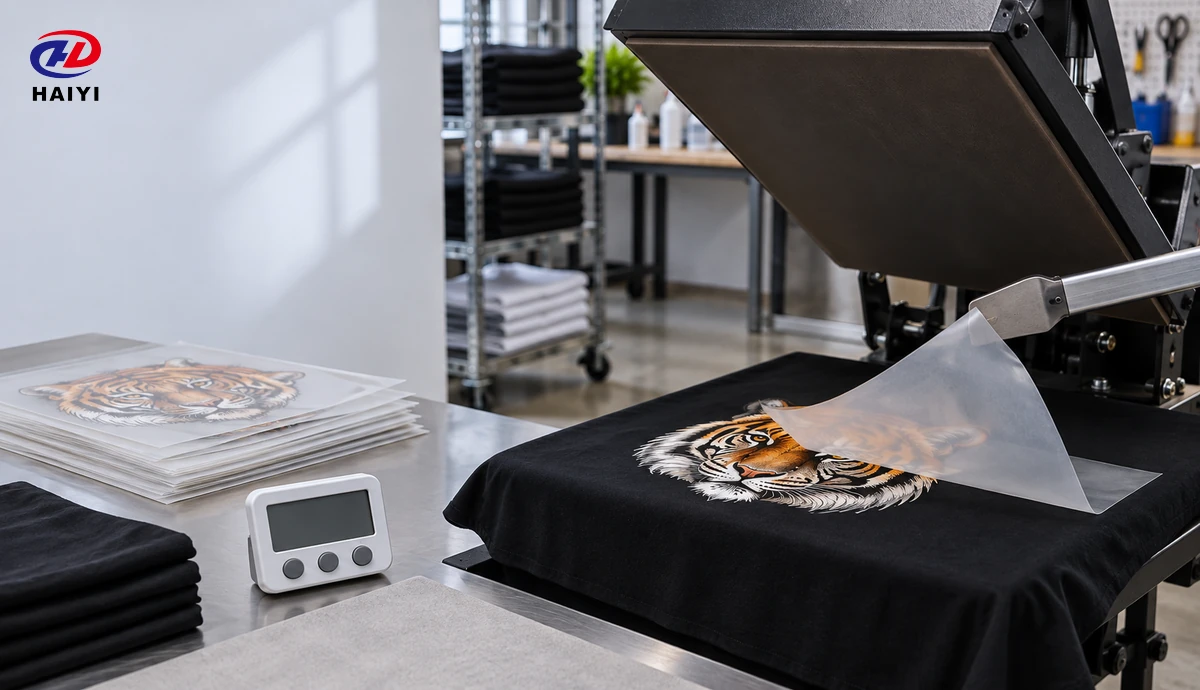
A useful process map begins when a transfer reaches the press and ends when the accepted garment enters the next controlled stage. Record garment preparation, positioning, press loading, press cycle, unloading, peel wait, carrier removal, visual inspection, post-press, cooling, sorting, and packing. The map should show where the garment waits, who owns each step, and how order identity is preserved.
Elapsed time and labor time should be recorded separately. Cold peel can increase elapsed time because the garment cools, but cooling does not always consume active labor. Hot peel can reduce elapsed time, but immediate carrier removal may require active attention. The better choice depends on whether the business is constrained by floor space, labor, press capacity, delivery lead time, or error risk.
Queue size should be observed during normal order peaks rather than one ideal sample. A cold-peel system may require racks, trays, cooling boards, garment identifiers, and first-in-first-out control. A hot-peel system may require tight synchronization between the press and peeling operator. An instant-peel system may reduce timing pressure only if the verified release window is broad enough for real variation.
How should press utilization affect the choice?
Press utilization improves when the next garment can be loaded without waiting for unrelated handling. A single operator may need to unload and peel before loading again, while a two-person cell can separate pressing from peeling. The same film can therefore produce different throughput in different staffing models.
Hot peel often fits a compact cell where the operator removes the carrier immediately and can inspect the result before moving on. The process should confirm that peeling does not delay the next load or create unsafe handling around hot garments. A validated sequence is more important than the nominal label.
Cold peel often fits a batch cell where pressed garments move to a marked cooling zone and another operator peels them later. This arrangement can protect press utilization when work-in-process is controlled. It can also create congestion when cooling racks fill, job identifiers are lost, or operators peel garments in the wrong order.
Instant peel may fit operations that need rapid removal but cannot maintain one narrow moment. The practical advantage is flexibility only when the product remains acceptable across the tested operator range. Buyers should not assume that instant means unlimited timing freedom or that every fabric and artwork behaves the same way.
How much cooling space can the production floor support?
Cold-peel workflow capacity depends on cooling area as well as press capacity. Each garment or panel needs a controlled place to rest without contamination, unwanted stacking, order mixing, or premature peeling. Large graphics, thick garments, insulating platen pads, room temperature, and airflow can change the time needed to reach the approved condition.
Cooling racks should preserve garment identity and prevent the transfer surface from contacting unsuitable materials. Trays or positions can be coded by job, press time, operator, or peel-ready status. A business with limited floor space may prefer a qualified hot or instant peel product, while a business with organized rack capacity may accept cold peel without losing control.
Which peel type is easiest to standardize for operators?
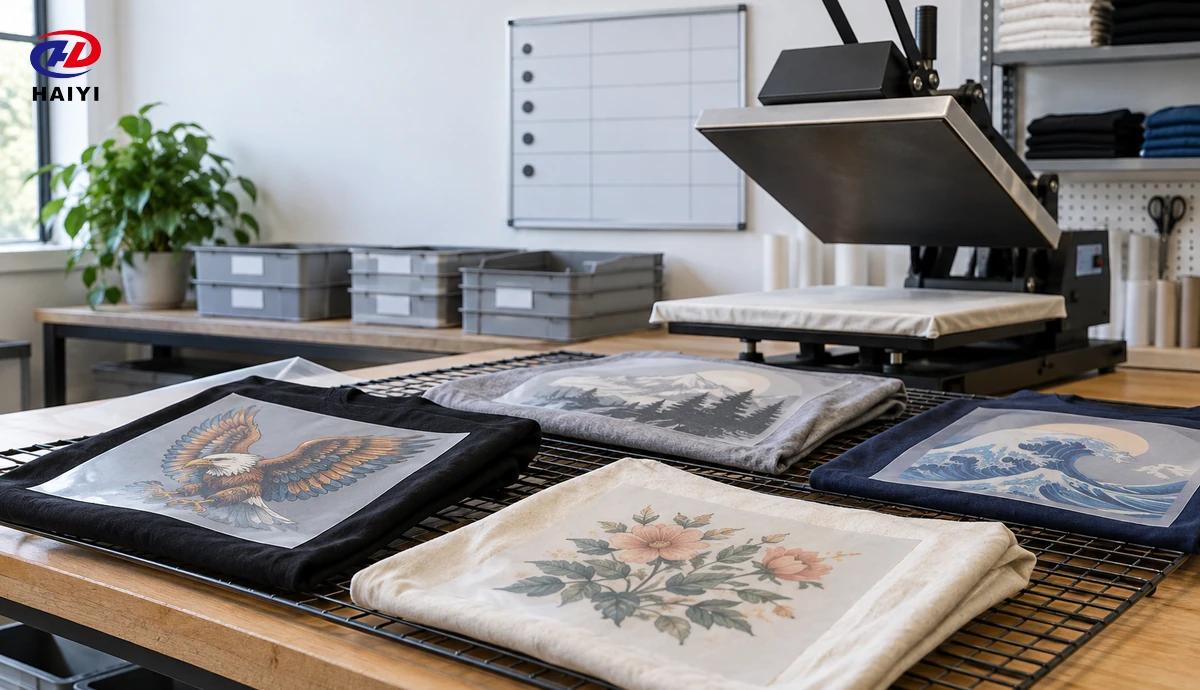
The easiest peel type is the type with a clear, observable, and forgiving rule in the actual workplace. A hot-peel product can be easy when the transfer releases consistently over the normal time between press opening and operator action. A cold-peel product can be easy when garments move through a controlled cooling queue. Instant peel can be easy when its broad window is proven rather than assumed.
Operator variation should be measured during qualification. Different trained operators can peel at slightly different times, speeds, angles, and directions. A candidate should remain acceptable across the intended operating range. A product that succeeds only for the most experienced operator may create hidden training and rework costs.
The final work instruction should state the film code, press condition, peel condition, maximum or minimum wait when relevant, garment handling, peel direction, peel speed, inspection points, post-press rule, and reaction to failure. Photographs can support the instruction, but the approved text should remain specific enough to use without personal memory.
Istniejący DTF film peel-window guide explains how to test multiple timing points and convert the result into an operator rule. The objective is to approve a usable window, not to capture one perfect demonstration at one exact moment.
How should mixed orders influence peel selection?
A mixed-order shop may process different garment fabrics, artwork sizes, colors, transfer suppliers, customer deadlines, and press conditions in one shift. Each additional peel rule increases the chance of using the wrong timing or mixing work-in-process. A simple portfolio can reduce cognitive load even when a specialized product performs slightly better in one narrow application.
One universal film should not be forced across applications that require different verified behavior. The better approach is a small controlled SKU set with clear use boundaries. Each SKU should have distinct packaging, identification, process instruction, storage location, and job-routing rule so operators can tell which peel procedure applies.
Color coding can support routing, but color alone should not be the only control because packaging can change and operators may misread similar labels. The film code should follow the roll, printed transfer, job ticket, press instruction, and retained record. Strong identity control prevents a peel failure from being diagnosed against the wrong product.
How should order mix and service model affect the decision?
A print shop producing finished garments controls pressing and peeling, so it can choose the film that best fits its own equipment, staffing, and production flow. A transfer seller ships printed and cured transfers to customers who may use different presses and operator habits. The transfer seller may place greater value on a clear customer instruction and a forgiving process window.
An on-demand shop with many small orders may value rapid visual confirmation and minimal staging. A large batch operation may value predictable queue control and division of labor. A mobile or compact operation may lack cooling-rack space, while a factory cell may have dedicated cooling and inspection stations. The best peel type changes with the operating model.
A distributor must evaluate more than one production line. Portfolio decisions should consider customer segments, support burden, sample training, packaging clarity, complaint diagnosis, inventory turns, and whether similar film labels create confusion. A smaller, well-documented range can create more value than several overlapping SKUs with unclear differences.
Should fabric or artwork determine the peel type?
Fabric and artwork should influence qualification, but neither should determine the peel type from a general rule. Cotton, blends, polyester, stretch fabrics, fleece, and treated garments can respond differently to heat, pressure, cooling, and adhesive flow. Large solids, fine lines, sharp corners, gradients, and small isolated details expose different release risks.
A candidate should be tested on the fabrics and artwork features that represent real sales and the most demanding normal use. If a business serves several application groups, the test matrix should show whether one film covers all approved groups or whether separate products are needed. Results should remain linked to the tested process and fabric lot.
Peel appearance should be evaluated together with adhesion, edge integrity, surface texture, flexibility, unwanted residue, stretch recovery, and required wash resistance. Easy carrier removal is not enough when the finished transfer fails another acceptance criterion. The selection decision should reflect complete accepted output rather than peel sensation alone.
How do you compare peel types fairly?
A fair comparison allows each product to use its approved peel condition while holding unrelated variables as consistent as practical. Forcing a cold-peel product into a hot-peel timing rule only proves that the wrong instruction was used. The comparison should ask which optimized and validated workflow best meets the business objective.
Start with the same printer, ink, powder, artwork, fabrics, curing equipment, heat press, environment, and inspection criteria. Establish a supplier-supported starting condition for each film, then confirm a usable process window. Record setup changes so that the final comparison describes complete film-process combinations rather than pretending that only the carrier changed.
Ten DTF peel-test SOP provides a controlled approach for artwork, samples, peel procedures, scoring, replicates, and operator instructions. Buyers developing the full material combination can also use the DTF consumables compatibility protocol to separate printing, powdering, curing, pressing, peeling, and finished-transfer observations.
What should the selection scorecard include?
A selection scorecard should combine output, workflow, and supply criteria. Output criteria can include release completeness, edge integrity, appearance, hand feel, adhesion, flexibility, and required durability. Workflow criteria can include press utilization, active labor, elapsed time, cooling space, queue size, operator variation, mixed-order control, inspection, and rework.
Supply criteria can include batch consistency, product identification, specification, peel-window evidence, sample traceability, packaging instructions, change notification, technical support, lead time, MOQ, and replacement availability. A strong test result can be undermined when future rolls are not controlled to the approved product.
Weights should reflect the business constraint. A high-volume garment factory may weight accepted output per press hour heavily. A transfer seller may weight customer process tolerance and instruction clarity. A distributor may weight SKU separation, repeat supply, support burden, and inventory exposure. No universal score weighting is correct for every buyer.
| Czynnik decyzyjny | Hot peel question | Cold peel question | Instant peel question |
|---|---|---|---|
| Czas odrywania | Can operators act inside the verified hot window? | Can the shop confirm the approved cooled condition? | How broad is the verified immediate or flexible window? |
| Press flow | Does immediate peeling delay the next load? | Can garments leave the press without waiting? | Does timing flexibility reduce press-side handling? |
| Work-in-process | Is staging minimal and clearly controlled? | Are racks, labels, and queue rules sufficient? | Can variable timing remain traceable? |
| Operator risk | How sensitive is output to a late or early peel? | How is premature peeling prevented? | Does the product tolerate normal operator variation? |
| Finished output | Does the validated process meet the same complete acceptance criteria? | ||
How should release force data be used?
Release force data can compare how the carrier separates under defined geometry, speed, specimen width, process, and peel condition. The number is useful for batch comparison and troubleshooting only when the method and product category remain controlled. A lower force is not automatically better because excessively easy release can also be unstable.
Hot, cold, and instant peel products should not share one arbitrary force limit because their release systems and approved conditions differ. Acceptance criteria should be established from a qualified product and process, then supported by visual transfer quality and functional checks. Instrument data should explain behavior rather than replace production approval.
Ten DTF release-force testing guide explains specimen preparation, peel geometry, force curves, replicates, measurement reliability, and product-specific acceptance. Most buyers can begin with a controlled operational comparison and request instrumented evidence when order risk or complaint analysis justifies it.
Compare total cost per accepted transfer
Film price per square meter does not capture the economic difference between peel workflows. Total cost can include press time, active labor, cooling racks, floor space, work-in-process, sorting, training, rejected transfers, garments lost to errors, repeat pressing, customer support, inventory, and changeover complexity.
A useful comparison records accepted transfers, total press time, active labor, elapsed time, rejected pieces, rework, cooling positions, and setup changes during a representative run. The result should be normalized to accepted output. Fictional assumptions should not replace observations from the actual production cell.
The lowest-cost film is the candidate that meets the complete output requirement with the lowest stable total cost and acceptable supply risk. A faster label is not valuable when it narrows the process window and raises rejection. A slower elapsed process can still be efficient when cooling uses little labor and the press continues running.
How should instant peel claims be verified?
An instant peel claim should be translated into a testable timing range. Ask whether the carrier is intended to be removed immediately after the press opens, after a short defined delay, while hot across a broad range, or under another supplier-defined condition. The answer should identify the exact SKU and process used to support the claim.
Qualification should include several planned peel times spanning the expected operator range, with replicates and the same finished-transfer acceptance criteria. The broadest successful interval is useful only when it also remains stable across representative fabrics, artwork, operators, and production variation. A single immediate peel does not prove a forgiving window.
Instant peel should be compared with qualified hot and cold alternatives rather than with poorly controlled examples. The buyer should measure whether the wider window reduces waiting, errors, and support cost enough to justify any price or supply difference. The label creates a hypothesis; the production trial creates evidence.
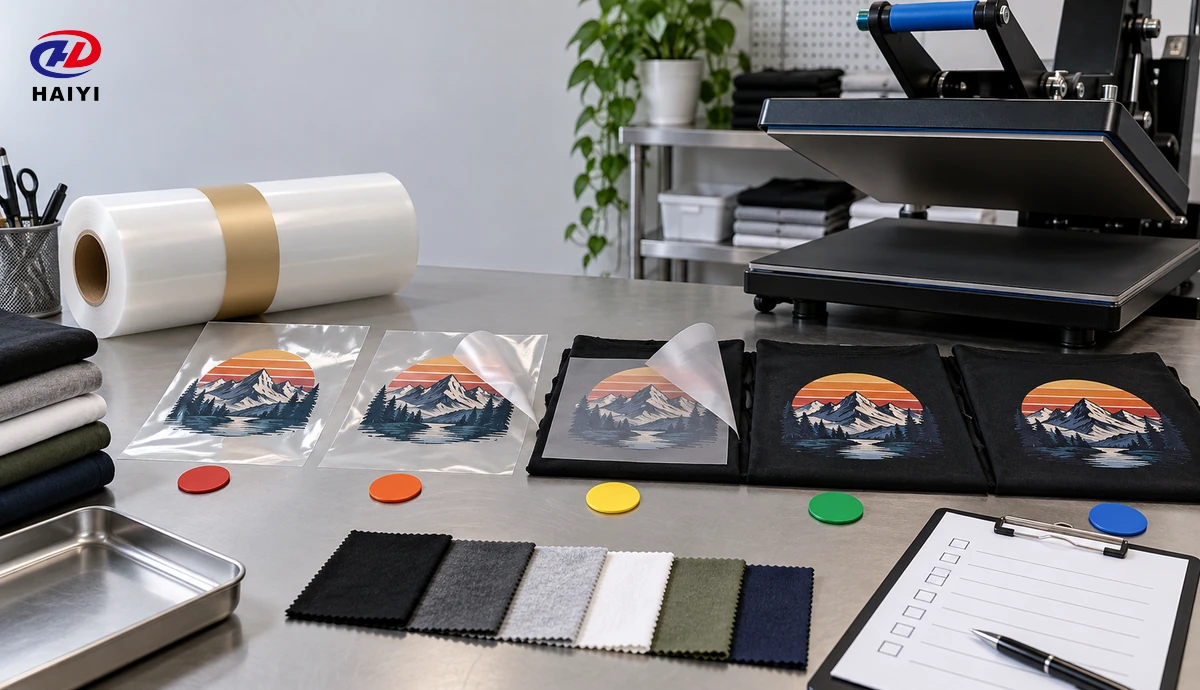
A practical selection sequence
- Define the business constraint. Identify whether press time, labor, floor space, elapsed time, operator variation, or customer support limits output.
- Map the production cell. Record loading, pressing, unloading, cooling, peeling, inspection, post-pressing, sorting, and packing.
- Choose relevant candidates. Request clearly identified hot, cold, and instant peel SKUs suited to the equipment, fabrics, and consumables.
- Qualify each process. Establish the supported press and peel condition for each product rather than forcing one rule across all films.
- Test the operating window. Include normal timing, operator, fabric, artwork, and environmental variation.
- Measure complete output. Track accepted yield, press utilization, active labor, elapsed time, staging, rework, and finished quality.
- Run a pilot. Verify commercial rolls, normal staff, peak queues, identification, instructions, packaging, and batch records.
- Control repeat supply. Preserve the approved film code, operator rule, reference samples, incoming checks, and change-notice requirement.
Często zadawane pytania
Is instant peel the same as hot peel?
Instant peel may be a form of very fast hot release, but the labels are not universally defined. Buyers should use the supplier instruction and validate the exact film. The important distinction is the approved timing window and result, not the marketing term.
Does cold peel always give better quality?
Cold peel does not automatically give better quality because finished results depend on the complete film, ink, powder, curing, pressing, fabric, timing, and handling system. Each candidate should be evaluated against the same output criteria using its approved process.
Is hot peel always faster?
Hot peel can reduce cooling delay, but workflow speed depends on press utilization, staffing, active labor, queue design, inspection, rework, and accepted yield. Measure the complete production cell rather than the peel action alone.
Can one shop use more than one peel type?
One shop can use multiple peel types when each SKU has a clear application, identity, storage location, job route, operator instruction, and approved process. Overlapping products without strong controls can increase errors and support cost.
What should a distributor request from the supplier?
A distributor should request exact product identity, peel definition, supported process window, compatibility guidance, samples, batch controls, packaging distinction, customer instructions, traceability, change notification, and a pilot path. The recently published DTF film buying guide provides a broader risk-based purchasing framework for samples, pilots, usable cost, and repeat supply.
Source the right DTF film workflow from Haiyi
Haiyi supplies wholesale and customized DTF film for distributors, print-supply businesses, importers, transfer sellers, and production users. A useful B2B inquiry should include the printer, ink, powder, curing equipment, heat press, fabrics, artwork mix, current peel workflow, daily volume, staffing, cooling space, roll format, packaging, and the production problem the buyer wants to solve.
To compare hot peel, cold peel, and instant peel options under a controlled production plan, skontaktuj się z Haiyi with your workflow and sample requirements. Haiyi can discuss suitable film formats, wholesale quantities, customized options, private-label packaging, and a pilot path. Final selection should remain tied to the buyer-approved consumables, process window, fabrics, output criteria, and production lots.